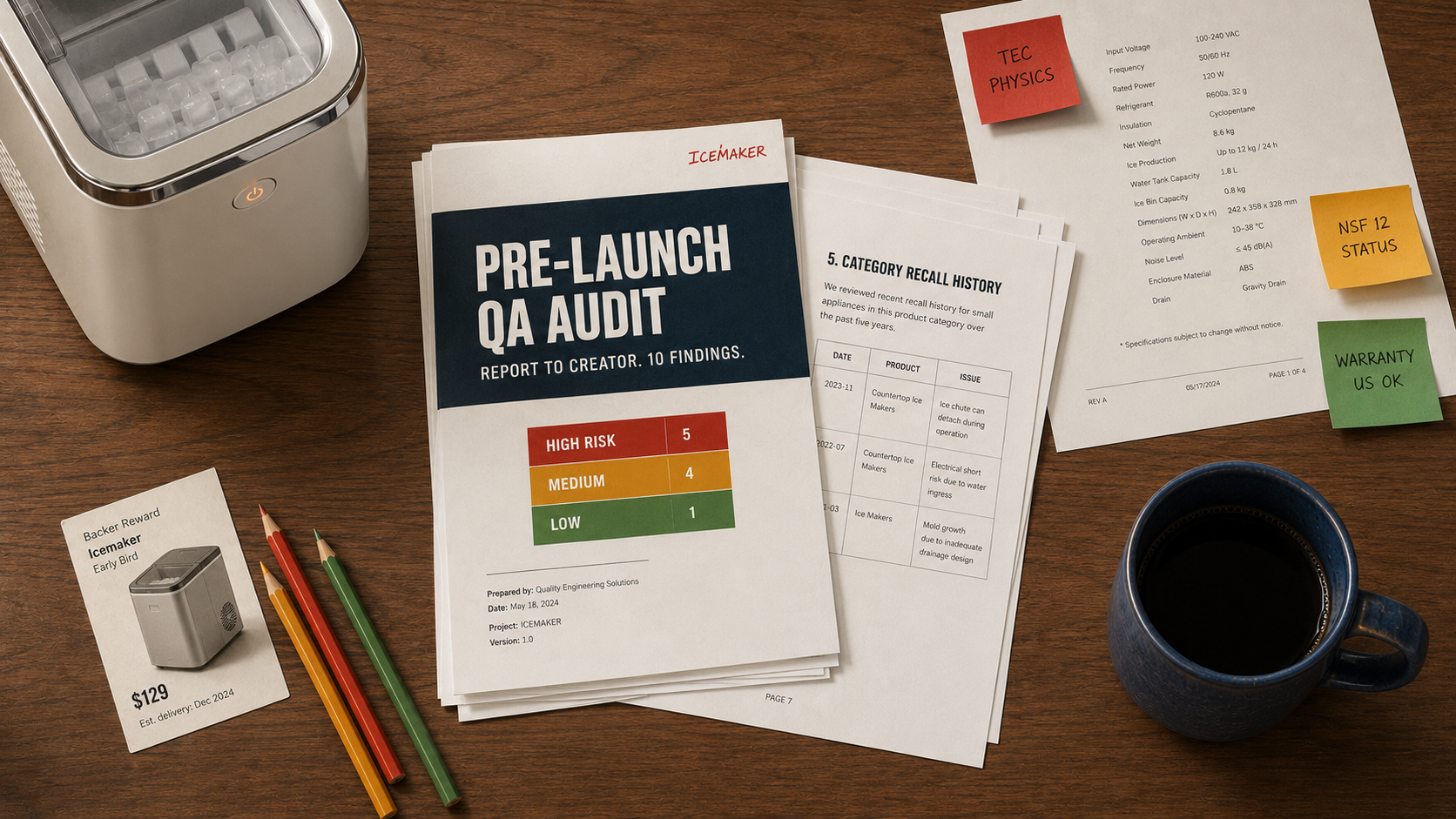
The Pre-Launch QA Audit methodology is published openly at qesaas.com/the-qa-audit. The 10 points are the same on every engagement. The findings are different on every engagement because the inputs are different.
This article walks through what those 10 points produce on a representative crowdfunded icemaker. Not a specific brand, not a single campaign, just the category as the audit reads it. The framework here is the framework delivered to paying engagements. The findings are illustrative, drawn from public spec sheets, the federal recall record, and the published reliability data on the dominant cooling technologies in this category.
The hypothetical creator
A US-based Kickstarter creator with a countertop icemaker in mid-campaign. Goal $25,000, trending toward $80,000. Target retail price $129. Manufacturing window opens in 60 days. ODM factory in Southeast Asia, identified but not yet visited by the creator. Cooling technology specified as thermoelectric (TEC) for the small form factor. Marketing claims include “first ice in 10 minutes” and “fits in a cup holder.”
Submitted to the audit:
- Public campaign page including the rewards tiers and the Risks and Challenges section
- Internal spec sheet, two pages
- ODM factory’s draft BOM, eight pages
- Three prototype photos
- One internal benchmark test report on cycle time at 25 °C ambient
- Two competitor product URLs the creator considers comparables
That is the entire input loop. No discovery call. The audit runs in parallel with the creator’s other launch work and delivers a written PDF in one week.
1. Materials and Construction
The audit reads the BOM line by line for the wetted parts and the load-bearing structural parts.
Findings on a representative icemaker:
- Wetted plastics specified only as “food-grade ABS” with no resin grade, no supplier name, and no 21 CFR Parts 174 through 178 attestation
- Water reservoir gasket specified as “silicone” with no shore hardness, no FDA compliance grade, and no leachables data
- Internal tubing specified as PE with no NSF 51 or NSF 61 certification cited
- Fasteners specified as zinc-plated steel for components that will sit in a high-humidity interior for the product’s life
Action. A two-page question list goes back to the ODM. Every wetted part needs a documented resin grade, a supplier name, and a 21 CFR food-contact attestation. Every metal part inside the interior humidity envelope needs a corrosion specification. The audit ranks this section high-risk on any icemaker because every flagged line above is a recall vector documented in the category.
2. Tolerances and Specifications
The audit reads the marketing claims and the spec sheet against the test data.
Findings on a representative icemaker:
- “First ice in 10 minutes” is supported by one benchmark test at 25 °C ambient. No data on warm-ambient operation (30 to 35 °C, common in summer kitchens and vehicle interiors) or on the second cycle of the day after the unit has equilibrated
- “Cycle time” is published as a single number with no tolerance band
- “Ice production per hour” is calculated from the 10-minute first-cycle figure, not measured over a one-hour run
Action. Three additional benchmark tests required before the spec sheet is finalized: warm-ambient (35 °C), cold-ambient (15 °C), and an hour-long continuous run starting from cold. The marketing claim either holds against the test data or it changes. Audit recommendation: change the claim now, not after the first one-star review compares 10 minutes promised to 22 minutes observed.
3. Failure Modes
The audit identifies the most likely failure modes for the product under normal use and foreseeable misuse.
Findings on a representative TEC icemaker:
- Condensation on cold-side surfaces below ambient dew point. The dominant non-mechanical failure mode for TEC modules per published Ferrotec and Same Sky reliability data. In an icemaker, condensation pools in the interior and seeds biofilm.
- Mechanical fracturing of the TEC module’s semiconductor pellets or solder joints under thermal cycling. The dominant mechanical failure mode. The unit goes dead with no graceful degradation.
- Mineral scale on the freezing surface from hard tap water. Reduces heat transfer over time, lengthens cycle time, defeats the published cycle-time spec by month six.
- Biofilm in the reservoir and the wetted tubing. The category-wide post-shipment customer-experience failure. Documented in the public complaint record for at least one major-brand icemaker over multi-year ownership horizons.
Action. Each failure mode gets a documented design mitigation or a documented user-facing cleaning protocol. Vague “self-cleaning” claims do not satisfy the audit. The mitigation has to be specific (sanitizer compatibility, cleaning cadence, sealed component design) and testable.
4. Manufacturer Track Record
The audit pulls the ODM’s track record across the US recall apparatus and the importer-of-record databases.
Findings on a representative icemaker:
- ODM has no prior US importer-of-record record visible in CPSC Section 15 reports, FDA Import Alert lists, or the publicly available NHTSA defect investigations
- Factory has shipped white-label appliances to several US Amazon-only brands over the past four years, none of which carry a federal recall record either
- Factory has no published ISO 9001 certification scope visible on the IAF CertSearch database
Action. Three options ranked from cheapest to most thorough: request the factory’s ISO 9001 certificate and audit scope letter, commission a third-party factory audit (typical cost $1,500 to $4,000), or engage SGS or Intertek for a pre-shipment inspection on the first production batch. The audit recommends at minimum the ISO 9001 certificate request before the deposit clears.
5. Category Recall History
The audit pulls 24 months of CPSC, FDA, USDA, and NHTSA recall data for the product category and clusters by failure mode.
Findings on the home-icemaker category (last 36 months):
- Gevi Household Countertop Nugget Ice Makers (CPSC, October 2023). Model GIMN-1102 manufactured before June 1, 2022. Approximately 8,800 units. The metal auger blade detached during operation and dropped pieces of metal into the ice basket. CPSC received 263 reports. Hazard: laceration from metal fragments in ice.
- Frigidaire Side-by-Side Refrigerators with Slim Ice buckets (Electrolux Group / CPSC, February 2024). Refrigerators manufactured 2015 to 2019, over 350,000 units. Ice bucket assembly cracked under normal operation and deposited plastic shards into the dispensed ice. 343 incident reports, two injuries. Hazard: choking and laceration.
- Frigidaire and Electrolux Refrigerators (Electrolux / CPSC, 2022). Earlier ice-maker choking-hazard recall on the same refrigeration platform.
- Scotsman Commercial Ice Cube Machines (CPSC, 2010). Fire hazard from the electrical assembly. Commercial product family, same engineering discipline gap that scales down into countertop units when the cost target is aggressive.
- Sanven / Vevor Ice Crushers (CPSC, 2026). Adjacent category. Two reports of thermal events including one fire.
- Samsung French Door Refrigerator ice-maker class action (settled December 2023). Models manufactured 2013 to 2017. Documented failure modes: plastic ice buckets cracking under thermal cycling, ice-maker icing-up and jamming, water leakage into the refrigerator compartment.
Cluster analysis. Five distinct failure modes across the category: metal fragments from ice-contact components, plastic shards from thermal-cycled ice-contact components, electrical thermal management failures, ice-maker freeze-up and jamming, biofilm and mold buildup in the reservoir. Every one of those modes is reachable on a TEC-cooled countertop unit if the corresponding design discipline is not applied.
Action. The creator’s spec sheet has to address each of the five clusters with a documented design choice or a documented user-facing mitigation. The audit produces a one-page table matching each cluster to the creator’s relevant spec line.
6. Regulatory Exposure
The audit produces a one-page regulatory exposure map for the product.
Findings on a representative icemaker:
- 21 USC 321(f) of the Federal Food, Drug, and Cosmetic Act. Ice is food. The ice produced by the unit is regulated as food, even though the consumer-owned appliance is not.
- FDA Food Code Section 4-204.110. Ice for use as food shall be made from drinking water. The user manual has to instruct the consumer that the unit ices only from drinking water and the design has to protect the ice from contamination.
- 21 CFR Parts 174 through 178. Indirect food additives. Every wetted plastic, gasket, and tubing material has to be on the FDA cleared-substances list for its intended use.
- NSF/ANSI 12, Automatic Ice Making Equipment. Voluntary in the consumer-appliance segment. Most low-cost crowdfunded units carry no NSF 12 mark. The audit recommends either certifying, publishing the in-process status, or documenting the rationale for skipping the certification. Silence on this point reads worse to a sophisticated backer than a clean disclosure.
- UL or ETL listing. Required for retail sale in the US and a prerequisite for major retailer onboarding (Target, Walmart, Costco, Best Buy, Home Depot, Lowe’s all require it).
- FCC Part 15 (Class B unintentional radiator). Required if the unit contains any digital electronics or any wireless component.
- California Prop 65. Required labeling assessment for any chemical on the listed-substances index appearing in the BOM.
Action. Each line gets a status (covered, in process, gap) and a target close date. The audit’s regulatory exposure section is the document the creator forwards to a retailer’s vendor compliance team during onboarding.
7. One-Star Review Patterns
The audit reads the public complaint record for the closest two or three comparable products on market.
Findings against the public review record for the closest comparable nugget-ice product family:
- Mold buildup in the reservoir within 12 to 18 months of normal use, even when owners follow manufacturer-prescribed cleaning. Owner quotes: “the interior was full of mold after 4 years,” “lasted about 18 months despite filtered water and monthly cleaning”
- Complete unit failure inside 6 weeks to 3 months on a meaningful fraction of units. Owner quote: “stopped working after about 6 weeks”
- Cleaning solutions (manufacturer-prescribed sanitizer, vinegar, bleach) reported as insufficient to clear biofilm once established
- Warranty support reported as slow or unresponsive after the first 30 days
Action. The creator’s product has to differentiate explicitly on the failure modes the comparable product has been one-star-reviewed for. A published cleaning protocol that addresses biofilm. A first-year warranty handled by a US-based support address with a documented response-time commitment. A serviceable design that allows the reservoir and tubing to be deep-cleaned without specialized tools.
8. Returns and Warranty Reality
The audit reads the warranty policy against how returns will be processed in practice.
Findings on a representative crowdfunded icemaker:
- Stated warranty: 12 months from delivery
- Warranty service handled by an ODM-supplied email address in the manufacturing country, no US phone number, no published response-time commitment
- Kickstarter reward fulfillment does not legally constitute a consumer purchase, so US state-level consumer-protection statutes (lemon laws, Magnuson-Moss) cover the product only after the first retail sale
- Defective-unit returns require the consumer to ship the unit internationally at the consumer’s expense unless explicitly disclaimed in writing
- No published refund policy for backers whose unit arrives defective
Action. Three changes the audit recommends before the manufacturing PO clears:
- Stand up a US-based support email or contracted service address, with a published response-time commitment. The cost is real but it is the difference between a 1-star review for the support experience and a 4-star review for the product.
- Publish a clear defective-unit replacement policy on the campaign page and on the eventual product packaging. Whichever party absorbs the international shipping cost has to be named explicitly.
- Carry the warranty terms intact when the product transitions from Kickstarter fulfillment to retail sale, so the post-Kickstarter buyer is not in a weaker position than the original backer.
9. Comparable Products
The audit reads two to three competitors on the relevant material, spec, and failure-mode dimensions and identifies the deltas.
Findings on the closest comparable countertop nugget-ice product:
- Comparable carries no NSF/ANSI 12 mark. Same gap as the creator’s product. The audit recommends differentiating by certifying.
- Comparable’s reservoir is opaque plastic with no UV-resistant treatment. Mold growth correlates with light exposure plus organic carbon plus standing water. The audit recommends a tinted or opaque reservoir paired with a designed-in light-blocking lid.
- Comparable’s drain plug requires the unit to be lifted and inverted to drain. This is the source of the “I can’t fully clean it” complaints in the public review record. The audit recommends a side-mounted drain valve.
- Comparable’s published cleaning protocol calls for monthly sanitizer use. The public review record shows owners not following it. The audit recommends a built-in cleaning-cycle indicator that prompts the user.
Findings on a second comparable, a vapor-compression countertop product:
- Vapor-compression unit cycles much faster than TEC. The creator’s product cannot compete on cycle time. The audit recommends repositioning the cycle-time claim to “compact form factor and travel-friendly DC operation,” neither of which the vapor-compression comparable can match.
Action. A one-page deltas table goes into the audit deliverable. The creator can use it to write a Risks and Challenges section that names the comparable products and the specific differentiators. Backers reward that disclosure with higher trust.
10. Risk-Ranked Verdict
Every finding from sections 1 through 9 sorted high, medium, or low. Each finding paired with a recommended action and a target close date. A yes / no / with-caveats recommendation on shipping the product as-currently-specified.
Sample verdict on the representative icemaker:
| Finding | Risk | Recommended action | Close before |
|---|---|---|---|
| Wetted plastics not attested to 21 CFR 174-178 | High | Factory documentation request | PO clears |
| TEC cycle time claim unsupported in warm ambient | High | Three additional benchmark tests, rewrite the claim | Final marketing lock |
| Biofilm management not designed-in | High | Sanitization protocol + drain valve redesign | Final BOM lock |
| ODM has no US importer track record | High | ISO 9001 certificate request, factory audit option | PO clears |
| No NSF/ANSI 12 status disclosed | Medium | Certify, publish in-process, or document skip rationale | Campaign close |
| No UL or ETL mark referenced | High | Engage UL or ETL evaluation | First retail listing |
| Warranty handled offshore | Medium | Stand up US support address | Fulfillment ship date |
| FDA Food Code drinking-water statement absent | Medium | Add to user manual | Final manual draft |
| 12-cube cycle claim from cold start | Medium | Add hour-long benchmark test | Final marketing lock |
| BPA / BPS attestation absent on reservoir | Medium | Factory documentation request | PO clears |
Recommendation: Do not ship as-currently-specified. The category recall record and the public complaint pattern make every finding above a reasonably foreseeable failure mode under normal use. With the close-out actions above completed before the PO clears, the recommendation flips to ship-with-caveats and the creator can publish a Risks and Challenges section that names each closure on the campaign page. Backers reward the disclosure with higher trust and lower refund-request volume in fulfillment.
What happens after the report is delivered
A 30-minute review call with the creator. The findings are walked through in priority order. Every action item is matched to a deadline tied to the creator’s actual launch calendar (campaign close, PO date, factory acceptance test, fulfillment ship date, first retail listing).
The creator forwards the report to the ODM, to any retail vendor compliance team in early conversations, and to a board or investor group if relevant. The report is written to be readable by a non-engineer. Findings cite the published standard, the federal regulation, or the specific named recall they reference. A reader on the receiving end does not have to take the auditor’s word for any finding.
That is the deliverable. 10 to 15 pages of PDF, 30-minute review call, written so a CEO or a retailer’s vendor compliance team can act on it directly.
Pricing
The first three Pre-Launch QA Audits are running at $750 in exchange for a written testimonial. Standard rate after those slots fill is $1,500, fixed price, one-week turnaround. Scoping calls are free, and if it isn’t a fit, we will say so before any invoice goes out.
For a Kickstarter creator currently in-campaign with a manufacturing window opening in the next 90 days, the audit fits inside the funding raise. Backers will never know it was run. They will only know the product they receive is well-built and that the Risks and Challenges section read like the creator had outside senior eyes on the launch.
Full audit detail: qesaas.com/services-pre-launch-audit
The 10-point methodology in full: qesaas.com/the-qa-audit
If you are running a consumer-product campaign with a manufacturing window opening in the next 90 days, send your spec sheet. The first half of any scoping call is figuring out whether the audit is worth your money. We will tell you if it isn’t.
Want this kind of analysis on a product you're shipping or a regulatory situation you're sitting in? Email Mark or book a scoping call. Initial conversations are free and NDA-able.
← All articles