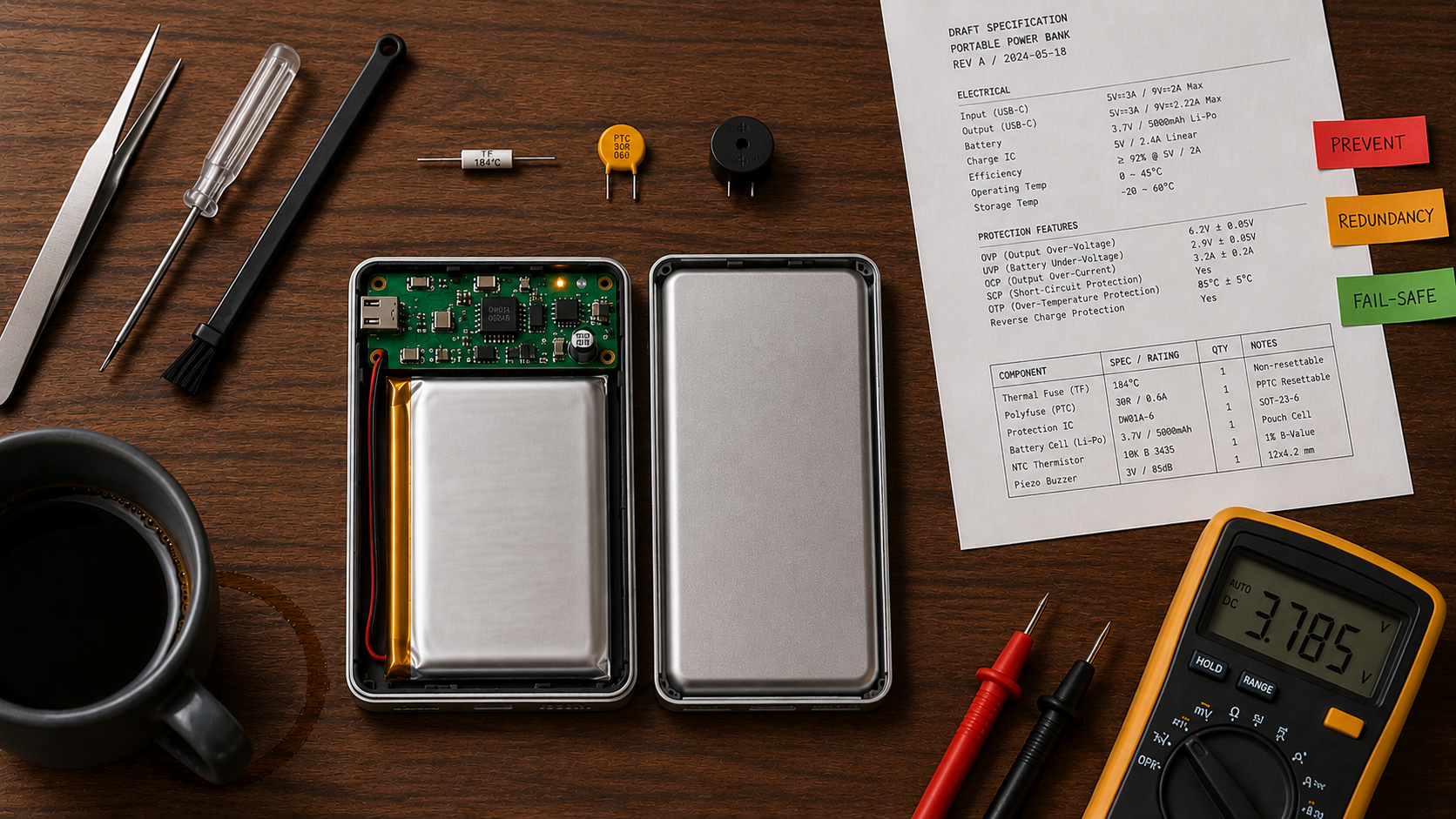
Fail-safe design is normally taught in the language of aerospace, automotive, and medical devices. The textbook examples are dual-redundant flight computers, ABS sensor failovers, defibrillator self-tests. The implicit assumption is that fail-safe engineering is a discipline for products with seven-figure development budgets and a regulator looking over the engineer’s shoulder.
That framing has cost the consumer hardware category in general, and the crowdfunded segment in particular, a generation of avoidable recalls.
The principles do not change when the budget falls. A $30 power bank, an $80 sous-vide stick, and a $129 countertop appliance can each be designed against the same four-step error-to-harm chain that aerospace engineers use. The implementations get cheaper. The discipline does not.
This article walks through the four levers a consumer-product engineer can apply on a Kickstarter-sized BOM. The components and design moves below typically add a dollar or two to a small-electronics BOM at volume. Each one closes a recall vector that has appeared somewhere in the public CPSC, FDA, or NHTSA record over the last decade.
The error-to-harm chain
An error becomes a failure. A failure becomes a hazardous situation. A hazardous situation becomes physical harm or economic loss. The job of design is to break the chain at one of those four points.
In a regulated-industry FMEA, every component on the BOM is enumerated against this chain. In a crowdfunded-product design review, that level of formal enumeration is rarely realistic. A senior engineer reading the same BOM identifies the top three to five chains that have already appeared in the category’s recall record and designs against those specifically. Most consumer-product recalls cluster on a small number of failure modes per category. The audit reads the BOM against that cluster, not against every theoretical fault.
The four levers, in order of where on the chain they intervene:
- Prevent the error. Simpler product, better-controlled line, harder-to-misuse interface.
- Add redundancy. Where one component can fail and another picks up the load.
- Fail to a safe state. When something does fail, it fails into a configuration that cannot make the situation worse.
- Notify the user. When the product can no longer protect itself, the human takes over — but only if the human knows it is happening.
Each lever has cheap implementations and expensive ones. The senior-engineer move is knowing which ones are non-negotiable for the category and which can be skipped.
1. Prevent the error
The cheapest fail-safe is a product that does not fail in the first place.
Simpler products fail less. A countertop appliance that ships with a single user-facing button and one mode of operation has a much smaller error surface than one with seven settings and a touchscreen. The seven-setting unit looks better on the campaign page. The single-button unit ships fewer one-star reviews.
Kickstarter creators frequently over-feature their first product because every feature is a campaign-page bullet. A senior pre-launch review asks which of those features the user actually engages with three months after delivery, and which ones are only adding error surface for the support team and warranty queue.
Manufacturing consistency is half the battle. A clean design specification poorly executed becomes a defect rate. A $40 power bank can be designed perfectly and still ship with a few percent short-circuit rate if the solder profile drifts during the third week of the production run. The fix is not in the design — it is in the supplier QA scorecard, the pre-shipment inspection cadence, and the supplier-side process controls. The audit reads both the design and the supplier’s process documentation.
Error-proof the user interaction. Where a single human action could trigger a failure, design the interaction so the action is physically impossible or requires a deliberate second confirmation. Cheap examples that appear in the federal record as missing-design recalls:
- A heated wearable with a power button that cannot be pressed accidentally inside a backpack.
- A camping stove fuel valve that cannot be left half-open while the user thinks it is closed.
- A reusable kitchen appliance with a sharp blade that physically cannot run when the lid is open.
- A child’s product with a battery compartment that requires a tool to open, not a fingernail.
Each of those is a mechanical decision under five dollars. Each closes a failure mode that has appeared in the federal recall record more than once.
2. Add redundancy where the cost is low
Redundancy is what aerospace engineers reach for first, and what consumer-product engineers usually skip first. The reflex is wrong in both directions.
On a Kickstarter BOM, full duplicate-component redundancy is rarely affordable. Partial redundancy almost always is.
The dumb backup behind the smart primary. A heating element controlled by a microcontroller and a thermistor is a smart primary. A bimetal thermal fuse rated 10 °C above the device’s working temperature is the dumb backup. The microcontroller manages cycle behavior. The thermal fuse exists for the case where the microcontroller hangs, the thermistor fails open, or the firmware enters a bad state. The thermal fuse adds cents to the BOM. It is the difference between a unit that shuts itself off when something goes wrong and a unit that catches fire.
Software watchdog timers. A zero-cost implementation. The microcontroller resets itself if its main loop has not executed in a specified interval. Catches firmware lock-ups before they sit in an unsafe state. Standard in every embedded-system reference design and frequently missed by consumer-product firmware teams under deadline pressure. The audit asks whether the watchdog is enabled in shipping firmware, not just in the prototype.
Over-current protection in two places. A polyfuse on the power input plus a protected battery management IC. Either alone is insufficient on a lithium-cell product. Both together is standard, adds a small handful of cents at volume, and closes the most expensive failure mode in the category.
The senior-engineer judgment is which redundancy is non-negotiable and which is overkill. The fail-safe behind the lithium cell is non-negotiable. A dual-redundant Bluetooth radio on a desk lamp is overkill. The audit produces that distinction explicitly so the creator does not waste BOM on the wrong protections.
3. Fail to a safe state
When something does fail, the question becomes: what state does the failed product land in? The principle is that the failed state should not be the most dangerous state.
The textbook example is the fail-open electric door lock: when power is lost, the lock releases so people are not trapped in a burning building. The principle scales down to consumer hardware:
Cut the power on thermal anomaly. Most modern consumer electronics include a thermistor and a controller that cuts the supply when the internal temperature exceeds a defined threshold. The cost of this protection is well under a dollar at volume. The cost of skipping it has appeared in the federal recall record under “thermal event, fire hazard” several times per year across categories from ice crushers to space heaters to consumer batteries.
Default to off, not on. A motorized appliance that loses its control signal should stop, not continue at full power. A heated wearable that loses radio link should drop to a known low-temperature setting, not stay at whatever the last command was. A smart plug that loses cloud connectivity should default to off on the next user interaction, not maintain whatever state it happened to be in.
Move to a configuration that cannot make things worse. A child’s nightlight that runs on a wall outlet and a 9V battery should default to the battery when the wall outlet fails — and the battery circuit should be the simpler one, with no software-controlled brightness modulation. A water-resistant flashlight that floods should fail dark rather than fail at maximum brightness with a thermal event a few minutes later.
The implementations vary by category. The principle does not. The failure mode should not be the dangerous configuration.
4. Notify the user
When the product can no longer protect itself, the user takes over. But only if the user knows.
The textbook example is the fire alarm wired to ring on circuit failure, not stay silent. If the circuit opens, the alarm rings; the user investigates; the false alarm is a small cost. The alternative — silent fail — is unacceptable.
On consumer hardware, the same logic produces specific design choices:
The status indicator that fails to alarm, not to silence. An LED status indicator that drives green when everything is fine should drive red — or blink — when its driving circuit fails. Not stay green. Not go dark. A failed indicator that still looks fine is worse than no indicator at all because it actively misleads the user.
Audible alarms for genuinely time-critical conditions. A smoke detector, a CO detector, a thermal-event alarm on a heated wearable. Audible is non-negotiable when the user might be asleep or unable to see the device. Cost: well under a dollar for a piezo buzzer and the trigger circuit.
Clear next-step instruction. A device that alerts is half the work. A device that alerts and tells the user what to do is the full work. “Unplug the device and contact support at [URL]” is more useful than a single beep and a red LED. A printed safety card in the box is cents at volume. A QR code that lands on a model-specific serviceable URL is cheaper still.
The category recall record is full of products that alerted correctly and still resulted in injury or property damage because the user did not know what the alert meant.
What the cheap-BOM constraint really means
The objection from a creator on a $50 BOM is reasonable: every cent counts, and adding a thermal fuse, a polyfuse, a piezo buzzer, and a printed safety card adds up.
The objection is wrong on the numbers. The components above, in total, add roughly a dollar or two to a typical small-electronics BOM at volume. They close the failure modes most likely to produce a recall in the consumer-electronics category. The math against the cost of a recall — units replaced, international shipping reversed, legal exposure, the reputation hit on the next campaign — is not close.
The objection is right that not every fail-safe pattern from aerospace applies. Dual-redundant flight computers do not fit on a $50 power bank. The senior-engineer move is knowing which fail-safe patterns scale down to consumer-product economics and which do not. Most of them do. The ones that do, do for a small fraction of a typical BOM.
The same logic applies on the manufacturing side. A pre-shipment inspection on a 1,000-unit Kickstarter run is a few hundred dollars through SGS or Intertek. A poka-yoke jig that prevents the line from assembling a unit with the polyfuse missing is a one-time tooling cost. These are not aerospace-scale investments. They are the scaled-down version of the same disciplines.
How the Pre-Launch QA Audit applies the framework
Sections 1, 3, and 5 of the published 10-point methodology all touch this framework. Materials and construction is where the fail-safe components live on the BOM. Failure modes is where the error-to-harm chains get enumerated for the specific product. Category recall history is where the public federal record names the failure modes that have already produced recalls in the category, so the audit can prioritize which fail-safe patterns are non-negotiable for the specific product under review.
The audit does not invent failure modes. It reads the BOM and the spec sheet against the failure modes that have been documented in the category and reports back which fail-safe patterns are present, which are missing, and which would not be worth the BOM cost on this specific product.
10 to 15 pages of PDF. One week. $1,500 fixed price, $750 for the first three engagements in exchange for a written testimonial.
Full audit detail: qesaas.com/services-pre-launch-audit
The 10-point methodology in full: qesaas.com/the-qa-audit
If you are running a consumer-product campaign with a manufacturing window opening in the next 90 days, send your spec sheet. The first half of any scoping call is figuring out whether the audit is worth your money. We will tell you if it isn’t.
Want this kind of analysis on a product you're shipping or a regulatory situation you're sitting in? Email Mark or book a scoping call. Initial conversations are free and NDA-able.
← All articles